Manufacturing Accounting & Production Concepts
Core architectural concepts: BoM explosions, double-entry WIP absorption, standard costing, and OEE.
1. Overview & Business Value#
This comprehensive operational guide details the architecture, business workflows, configuration parameters, and execution steps for Manufacturing Accounting & Production Concepts within SmartERP.
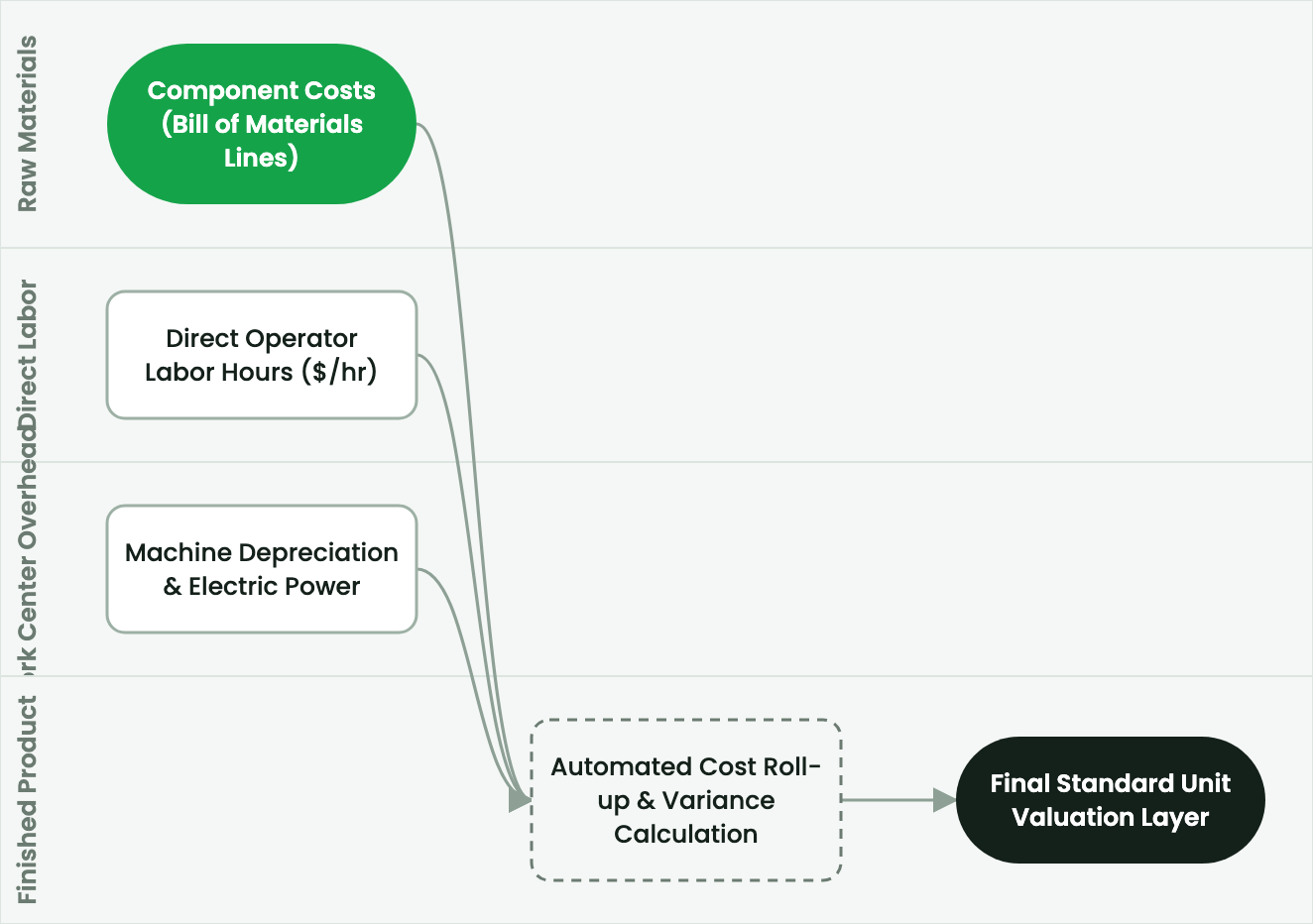
Core architectural concepts: BoM explosions, double-entry WIP absorption, standard costing, and OEE.
2. Prerequisites & Security Access Groups#
- Required Modules:
mrp, quality_control, smarterp_manufacturing_costing - Security Groups:
Manufacturing User(Technical ID:mrp.group_mrp_user)Manufacturing Administrator(Technical ID:mrp.group_mrp_manager)Quality Inspector(Technical ID:quality.group_quality_user)
- Master Data Dependencies: Bills of Materials (BoM), routing operations, work centers with machine/labor hourly rates, raw material stock, and inspection checkpoints.
3. Step-by-Step Configuration & Execution#
Step 1: Navigating to the Interface#
- Log into your SmartERP instance at
https://smarterp.et/odoo. - Open the main App Switcher (grid icon in the top-left corner).
- Navigate to Manufacturing → Configuration → Settings.
Step 2: Operational Data Parameters & Controls#
Ensure all mandatory parameters comply with enterprise operational standards:
- Authorized Operator: Action executed under assigned RBAC permissions (Production Engineer, Industrial Designer).
- Relational Integrity: Linked to upstream customer, product, inventory lot, or manufacturing order.
- Statutory & Quality Controls: Verified against Ethiopian commercial and tax regulations or technical engineering specifications.
Step 3: Operational Execution & State Progression#
- State Progression Gate: Advance record from Draft through Confirmed to Completed / Posted.
- Integrated System Impact: Automatically updates inventory stock quants, customer receivables, or work-in-progress cost accounting ledgers.
- Audit Verification: System registers tamper-evident audit records logging user ID, timestamp, and cryptographic transaction digests.
Core Production Mechanics#
Manufacturing in SmartERP is governed by double-entry operational and financial accounting. Every material conversion on the shop floor triggers simultaneous updates to inventory quants, analytic accounts, and general ledger journals.
The Bill of Materials (BoM) Explosion#
A Bill of Materials defines the engineering recipe for a product. When a Manufacturing Order (MO) is confirmed, SmartERP executes a BoM explosion:
- Level 0: Finished Good (e.g., Corrugated Steel Roofing Sheet 3m).
- Level 1: Semi-Finished Goods (e.g., Galvanized Steel Coil Strip) and direct raw materials.
- Level 2: Raw chemical coatings, zinc ingots, and packaging materials.
The system determines whether intermediate sub-assemblies should be manufactured via child MOs or treated as phantom kits that explode directly into the parent assembly.
Double-Entry WIP and Absorption Accounting#
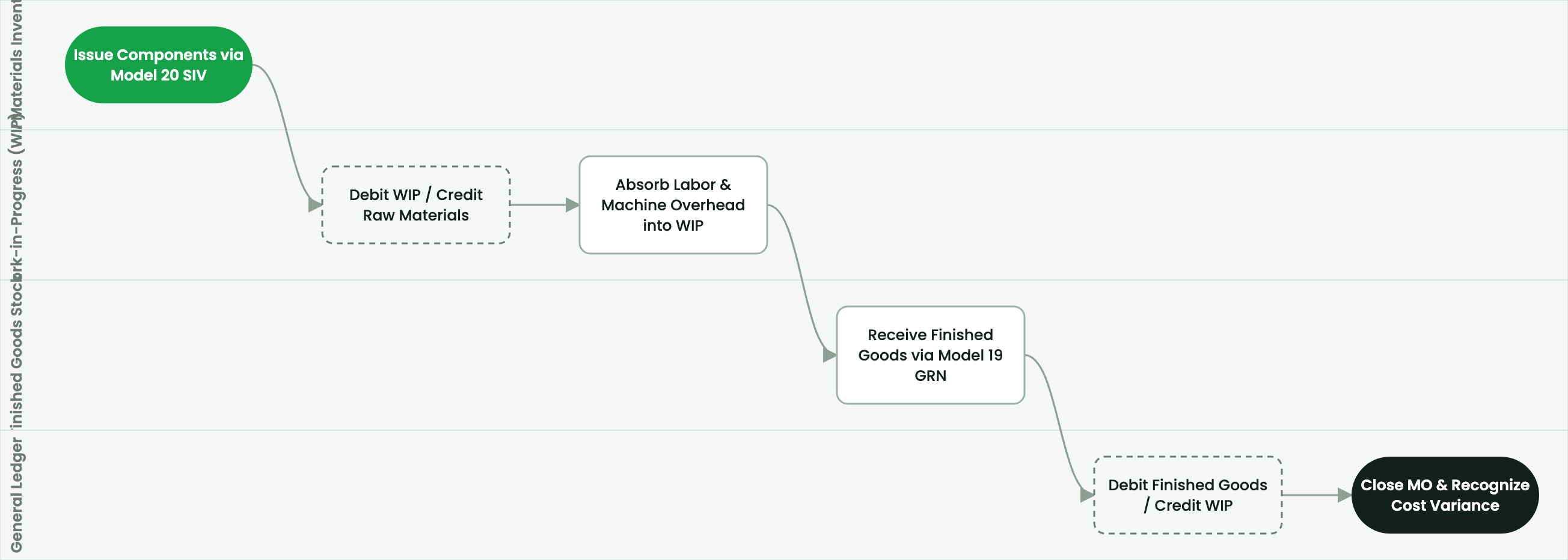
Unlike simplistic ERP systems that record product costs only upon receipt, SmartERP tracks cost evolution across three continuous stages:
- Raw Material Issuance:
- Debit: Work-in-Progress (WIP) Inventory Account (
103100) - Credit: Raw Materials Inventory Asset Account (
102100)
- Debit: Work-in-Progress (WIP) Inventory Account (
- Operational Overhead & Direct Labor Absorption:
- Debit: Work-in-Progress (WIP) Inventory Account (
103100) - Credit: Direct Labor Absorption Recovery Account (
502100) - Credit: Machine Overhead Absorption Recovery Account (
502200)
- Debit: Work-in-Progress (WIP) Inventory Account (
- Finished Goods Receipt:
- Debit: Finished Goods Inventory Asset Account (
104100) - Credit: Work-in-Progress (WIP) Inventory Account (
103100)
- Debit: Finished Goods Inventory Asset Account (
Overall Equipment Effectiveness (OEE)#
SmartERP calculates OEE across all active work centers to quantify production line efficiency:
$$\text{OEE} = \text{Availability} \times \text{Performance} \times \text{Quality}$$
- Availability: Actual operating time divided by planned production time (penalized by breakdowns, setup delays, and raw material stockouts).
- Performance: Actual units produced per hour divided by standard engineering design speed.
- Quality: Defect-free units (first-time pass) divided by total units produced.
By-Products, Co-Products, and Scrap Taxonomy#
- Finished Good: The primary output intended for customer sale or inventory stocking.
- Co-Product: A secondary valuable product generated simultaneously (e.g., refined oil and press cake during oilseed extraction). Cost is apportioned based on relative sales value.
- By-Product: A minor secondary output with nominal market value (e.g., sawdust in timber mills).
- Scrap / Spoilage: Damaged, off-spec, or waste material that cannot be used. Normal scrap is absorbed into product cost; abnormal scrap is expensed immediately to profit and loss.
4. Advanced Configuration Points#
- Automated Actions & Scheduled Tasks (Crons):
MRP: Recalculate BoM standard costs(mrp.ir_cron_bom_cost_roll): Runs weekly to update standard costing from latest procurement purchase pricesQuality: Trigger periodic inspection alerts(quality.ir_cron_inspection_check): Runs daily to flag mandatory quality testing queuesWorkcenter: Update OEE statistics(mrp.ir_cron_workcenter_oee): Runs hourly to compute Overall Equipment Effectiveness metrics
- Custom Print Templates & Reports:
- Production Order Traveler & Pick List
- Shop Floor Work Order Execution Slip
- Quality Inspection Certificate & Non-Conformance Report
- Manufacturing Cost Analysis & Variance Ledger
- Multi-Company Rules: Record-level security isolation under Company 1 (
Ashewa Technology Solutions S.C.), preventing cross-company ledger leakage across parent and subsidiary legal entities.
5. Comprehensive Troubleshooting Matrix#
| Error Symptom / Exception | Probable Root Cause | Corrective Action / Resolution |
|---|---|---|
BoM Missing Error: No active Bill of Materials found | Product variant lacks a verified and confirmed BoM in the system. | Create and confirm an active BoM under Manufacturing → Products → Bills of Materials. |
Component Shortage Block: Insufficient stock | Raw material components have not been transferred to the shop floor location. | Execute an internal transfer from main warehouse to production staging location. |
Quality Gate Blocked: Mandatory test failed | Work order failed critical quality tolerance threshold. | Perform required corrective rework or request authorized Quality Manager override. |
Workcenter Capacity Overload | Scheduled production duration exceeds available work center shift capacity. | Adjust scheduled start dates or distribute load across alternative work centers. |