Member Onboarding & KYC Statutory Verification
Manage member registration, verify National Fayda ID and Kebele credentials, enforce common bond rules, and designate beneficiaries.
1. Overview & Business Value#
This comprehensive operational guide details the architecture, business workflows, configuration parameters, and execution steps for Member Onboarding & KYC Statutory Verification within SmartERP.
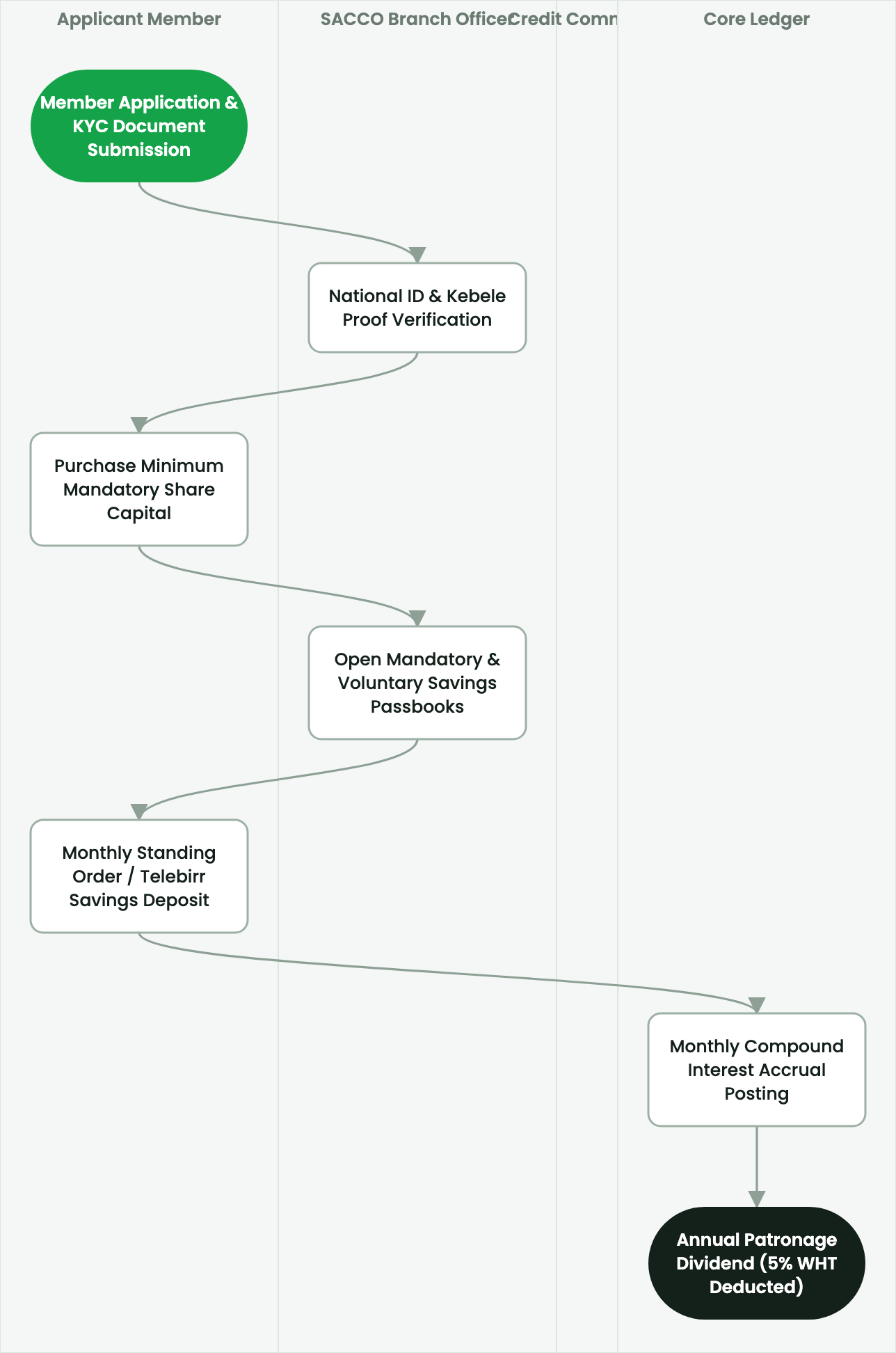
Manage member registration, verify National Fayda ID and Kebele credentials, enforce common bond rules, and designate beneficiaries.
2. Prerequisites & Security Access Groups#
- Required Modules:
smarterp_sacco_core, smarterp_equb, smarterp_loan_management - Security Groups:
SACCO Loan Officer(Technical ID:smarterp_sacco.group_sacco_officer)SACCO Credit Committee Member(Technical ID:smarterp_sacco.group_sacco_committee)SACCO General Manager(Technical ID:smarterp_sacco.group_sacco_manager)
- Master Data Dependencies: Member KYC profiles, share capital registers, savings product tiers, loan products with reducing-balance schedules, and Equb rotational pool configurations.
3. Step-by-Step Configuration & Execution#
Step 1: Navigating to the Interface#
- Log into your SmartERP instance at
https://smarterp.et/odoo. - Open the main App Switcher (grid icon in the top-left corner).
- Navigate to SACCO Core → Member Accounts; Loans → Active Loans.
Step 2: Operational Data Parameters & Controls#
Ensure all mandatory parameters comply with enterprise operational standards:
- Authorized Operator: Action executed under assigned RBAC permissions (SACCO General Manager, Loan Appraisal Officer, Cashier).
- Relational Integrity: Linked to upstream master records, approval requests, or transactional ledgers.
- Statutory & Quality Controls: Verified against Ethiopian statutory regulations and corporate governance standards.
Step 3: Operational Execution & State Progression#
- State Progression Gate: Advance record from Draft through Audited to Confirmed / Certified.
- Integrated System Impact: Automatically updates real-time operational states and posts financial/inventory journal moves.
- Audit Verification: System registers tamper-evident audit records logging user ID, timestamp, and cryptographic transaction digests.
Common Bond Membership Criteria#
Under ECC Proclamation No. 985/2016, a primary SACCO must establish a defined common bond defining eligibility:
- Institutional / Workplace SACCO: Employees of a specific enterprise (e.g., Ethiopian Airlines, Ethio Telecom).
- Geographic / Community SACCO: Residents of a defined Sub-City, Woreda, or Rural Kebele.
- Associational SACCO: Members of an occupational guild (e.g., Teachers' Cooperative, Traders' Union).
Step-by-Step Member Onboarding#
- Navigate to SACCO > Members > All Members and click New.
- Record primary biographical attributes:
- Full Legal Name: Grandfather-father-first name patronymic convention in Amharic and Latin script.
- National ID / Fayda Number: 12-digit national digital identity.
- Kebele Resident Identification: Sub-City, Woreda, House Number, Resident ID expiration date.
- Employment & Income Verification: Employer name, job title, gross monthly salary, net disposable income.
- Upload mandatory KYC documentation:
- Scanned passport-size photograph.
- Scanned Kebele/National ID card (front and back).
- Letter of employment and payroll deduction agreement (for workplace SACCOs).
- Record Nominee Beneficiary Information:
- Full name, relationship, national ID, contact telephone, and allocated benefit percentage (total must equal exactly 100%).
- Click Verify KYC & Matriculate Member.
Member Exit & Share Withdrawal Protocols#
When a member petitions to withdraw from the cooperative:
- Verify that the member has zero active outstanding loan balances.
- Verify that the member does not act as an active guarantor on any delinquent peer loan.
- Under ECC regulations, share capital cannot be withdrawn immediately; it must be transferred to an incoming member or refunded after a statutory 90-day notice period following annual audit closure.
4. Advanced Configuration Points#
- Automated Actions & Scheduled Tasks (Crons):
SACCO: Accrue monthly member savings interest(smarterp_sacco.ir_cron_savings_interest): Runs on the final day of each calendar month to credit interestLoan: Evaluate 5-tier NBE delinquency classification(smarterp_sacco.ir_cron_loan_delinquency): Runs nightly to compute loan loss provisions per NBE directivesEqub: Execute scheduled lottery draw(smarterp_sacco.ir_cron_equb_draw): Runs on defined pool cycle dates using provably fair random selection
- Custom Print Templates & Reports:
- Member Savings Passbook & Transaction Ledger
- Loan Amortization Schedule (Reducing Balance)
- NBE 5-Tier Delinquency & Loan Loss Provisioning Statement
- Annual Patronage Dividend Distribution Schedule
- Multi-Company Rules: Record-level security isolation under Company 1 (
Ashewa Technology Solutions S.C.), preventing cross-company ledger leakage across parent and subsidiary legal entities.
5. Comprehensive Troubleshooting Matrix#
| Error Symptom / Exception | Probable Root Cause | Corrective Action / Resolution |
|---|---|---|
Loan Blocked: Exceeds 3x savings ceiling | Requested loan principal exceeds 300% of member unencumbered savings balance. | Increase compulsory savings deposit or provide authorized co-signers with sufficient collateral. |
Equb Draw Blocked: Participant arrears detected | Selected Equb member has unpaid rotational dues in current or prior cycles. | Collect outstanding contribution payment before executing lottery draw. |
Share Capital Limit Error: Member exceeds 10% ceiling | Subscribed shares exceed statutory maximum under Proclamation No. 985/2016. | Restrict share allocation to maximum allowable 10% total cooperative equity threshold. |
Last updated: 2026-11-15