Configure fiscal periods and journals
Set up fiscal years, opening and closing dates, Pagume 13th-month handling, and transaction journals.
1. Overview & Business Value#
This comprehensive operational guide details the architecture, business workflows, configuration parameters, and execution steps for Configure fiscal periods and journals within SmartERP.
This guide is for Finance Managers and Administrators configuring financial calendars and journals.
2. Prerequisites & Security Access Groups#
- Required Modules:
account, smarterp_finance, smarterp_ethiopian_payroll - Security Groups:
Show Full Accounting Features(Technical ID:account.group_account_user)Billing Administrator / Financial Controller(Technical ID:account.group_account_manager)Chief Financial Officer / Auditor(Technical ID:account.group_account_readonly)
- Master Data Dependencies: Chart of accounts, statutory tax definitions (VAT 15%, WHT 2%/30%), payment terms, and open fiscal periods for Company 1 (Ashewa Technology Solutions S.C.).
3. Step-by-Step Configuration & Execution#
Step 1: Navigating to the Financial Interface#
- Log into your SmartERP instance at
https://smarterp.et/odoo. - Open the main App Switcher (grid icon in the top-left corner).
- Navigate to Accounting → Configuration → Accounting → Fiscal Years & Journals.
Step 2: Financial Parameters & Statutory Controls#
Ensure all mandatory accounting parameters conform to statutory fiscal regulations:
- Designated Authority / Role: Action authorized by verified financial role (Financial Controller, System Administrator).
- Fiscal Period & Journal Integrity: Bound to an open, unlocked fiscal period adhering to the Ethiopian financial calendar.
- Statutory Tax & Regulatory Validation: Compliant with Ethiopian Proclamation No. 979/2016 (Withholding Tax 2%/30%) and Proclamation No. 1157/2019 (VAT 15%).
Step 3: Transaction Posting & General Ledger Impact#
- State Progression Gate: Advance record from Draft through Audited to Posted / Reconciled.
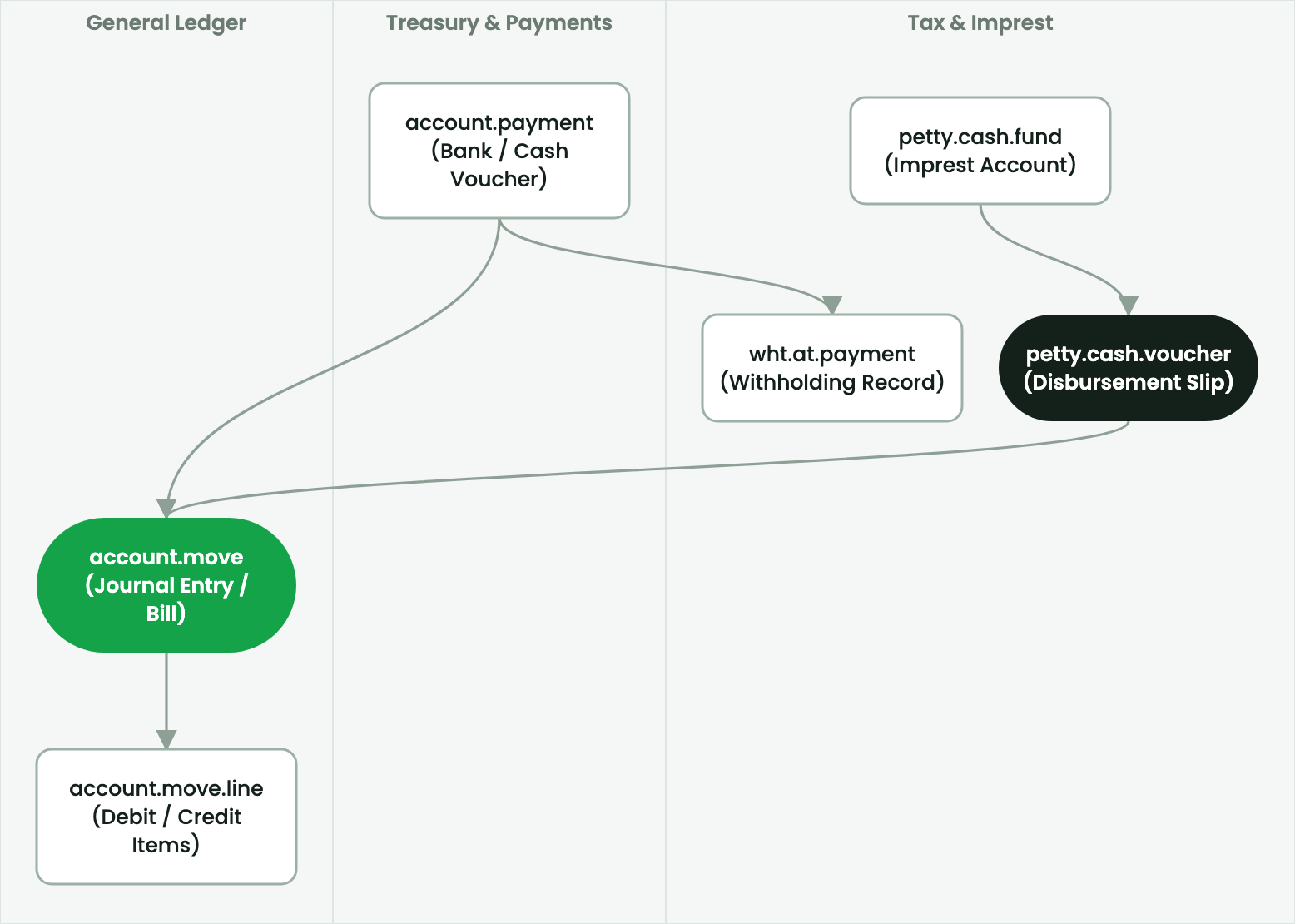
- Double-Entry General Ledger Impact: System automatically generates immutable journal items (
account.move.line) updating real-time trial balances and customer/vendor sub-ledgers. - Audit Verification: System registers tamper-evident audit records logging user ID, timestamp, and cryptographic transaction digests.
Fiscal periods and Ethiopian calendar alignment#
SmartERP supports Gregorian calendar fiscal years (e.g. July 8 to July 7 per Ethiopian fiscal calendar or January 1 to December 31).
- Open Accounting → Configuration → Fiscal Years → Fiscal Periods.
- Press New.
- Enter Period Name (e.g.
2026-M01 July,2026-M13 Pagume). - Select Start Date and End Date.
- Set Period Status to
Open.
Set up transaction journals#
Journals categorize and sequence accounting movements. Open Accounting → Configuration → Accounting → Journals.
SmartERP requires five primary journal types:
- Bank Journals: CBE, Awash Bank, Dashen Bank, Telebirr Merchant.
- Cash Journals: Main Safe Cash, Branch Cash.
- Sales Journals: Customer VAT Invoices.
- Purchase Journals: Vendor Bills and Commercial Claims.
- Miscellaneous Journals: Accruals, JVs, and Payroll Postings.
4. Advanced Configuration Points#
- Automated Actions & Scheduled Tasks (Crons):
Account: Automatic reconciliation(account.ir_cron_auto_reconcile): Runs nightly to match open ledger transactionsAsset: Compute depreciation lines(account_asset.ir_cron_compute_depreciation): Runs monthly on the 30th to compute fixed asset depreciation schedulesTax: Generate VAT and WHT schedules(smarterp_finance.ir_cron_tax_schedules): Runs monthly to prepare MOR tax return summaries
- Custom Print Templates & Reports:
- Official Cash Receipt Voucher (CRV)
- Bank Payment Voucher (BPV) & Cheque Payment Voucher (CPV)
- Withholding Tax Certificate (Form 3.4)
- General Ledger & Trial Balance Audit Schedules
- Multi-Company Rules: Record-level security isolation under Company 1 (
Ashewa Technology Solutions S.C.), preventing cross-company ledger leakage across parent and subsidiary legal entities.
5. Comprehensive Troubleshooting Matrix#
| Error Symptom / Exception | Probable Root Cause | Corrective Action / Resolution |
|---|---|---|
Access Rights Error: Operation not allowed on account.move | User account lacks accounting operator privileges. | Assign the user to account.group_account_user or account.group_account_manager under Settings → Users. |
Validation Error: Missing analytic distribution | Selected general ledger account mandates cost center allocation for IFRS compliance. | Populate the analytic distribution column on all debit and credit lines before posting. |
Posting Blocked: Fiscal period closed | Transaction date falls within an immutable locked accounting period. | Select a transaction date within the open fiscal year or request an authorized period reopening under Accounting Settings. |
Tax Imbalance: WHT withholding variance | Withholding deduction does not match statutory 2% goods or 30% service rate. | Verify vendor TIN registration status in partner master and recalculate statutory tax lines. |
Next#
- Issue a Cash Receipt: Issue cash receipt voucher.
- Issue a Bank Payment: Issue bank payment voucher.