Concepts and accounting principles
Core accounting equations, Ethiopian Chart of Accounts hierarchy, voucher taxonomy, withholding tax mathematics, and imprest fund theory.
1. Overview & Business Value#
This comprehensive operational guide details the architecture, business workflows, configuration parameters, and execution steps for Concepts and accounting principles within SmartERP.
This page explains the fundamental concepts and rules governing SmartERP Financial Operations. It is written for Accountants, Controllers, and Financial Auditors.
2. Prerequisites & Security Access Groups#
- Required Modules:
account, smarterp_finance, smarterp_ethiopian_payroll - Security Groups:
Show Full Accounting Features(Technical ID:account.group_account_user)Billing Administrator / Financial Controller(Technical ID:account.group_account_manager)Chief Financial Officer / Auditor(Technical ID:account.group_account_readonly)
- Master Data Dependencies: Chart of accounts, statutory tax definitions (VAT 15%, WHT 2%/30%), payment terms, and open fiscal periods for Company 1 (Ashewa Technology Solutions S.C.).
3. Step-by-Step Configuration & Execution#
Step 1: Navigating to the Financial Interface#
- Log into your SmartERP instance at
https://smarterp.et/odoo. - Open the main App Switcher (grid icon in the top-left corner).
- Navigate to Accounting → Configuration → Settings.
Step 2: Financial Parameters & Statutory Controls#
Ensure all mandatory accounting parameters conform to statutory fiscal regulations:
- Designated Authority / Role: Action authorized by verified financial role (Financial Controller, Chief Accountant, Systems Auditor).
- Fiscal Period & Journal Integrity: Bound to an open, unlocked fiscal period adhering to the Ethiopian financial calendar.
- Statutory Tax & Regulatory Validation: Compliant with Ethiopian Proclamation No. 979/2016 (Withholding Tax 2%/30%) and Proclamation No. 1157/2019 (VAT 15%).
Step 3: Transaction Posting & General Ledger Impact#
- State Progression Gate: Advance record from Draft through Audited to Posted / Reconciled.
- Double-Entry General Ledger Impact: System automatically generates immutable journal items (
account.move.line) updating real-time trial balances and customer/vendor sub-ledgers. - Audit Verification: System registers tamper-evident audit records logging user ID, timestamp, and cryptographic transaction digests.
Double-Entry Accounting Foundation#
SmartERP operates on strict double-entry principles. Every transaction consists of a balanced journal entry (account.move) where total debits strictly equal total credits:
$$\sum \text{Debits} = \sum \text{Credits}$$
The general balance sheet equation is maintained continuously across all fiscal periods:
$$\text{Assets} = \text{Liabilities} + \text{Equity}$$
$$\text{Net Income} = \text{Revenue} - \text{Cost of Goods Sold (COGS)} - \text{Operating Expenses (OPEX)}$$
Ethiopian Chart of Accounts (COA) Hierarchy#
SmartERP organizes the Chart of Accounts using standard 4-digit and 6-digit Ethiopian commercial structures:
| Account Code Range | Category | Financial Statement | Normal Balance |
|---|---|---|---|
100000–199999 | Current & Non-Current Assets | Balance Sheet | Debit |
200000–299999 | Liabilities (Accounts Payable, Tax Payable) | Balance Sheet | Credit |
300000–399999 | Equity & Retained Earnings | Balance Sheet | Credit |
400000–499999 | Operating & Non-Operating Revenue | Profit & Loss | Credit |
500000–599999 | Cost of Goods Sold (COGS) | Profit & Loss | Debit |
600000–699999 | Operating Expenses (Administrative & Selling) | Profit & Loss | Debit |
700000–799999 | Finance Costs & Other Expenses | Profit & Loss | Debit |
Vouchers vs. Journal Entries#
SmartERP differentiates between raw General Ledger journal entries and user-facing commercial vouchers:
- Journal Entry (
account.move): The internal double-entry container comprising debit and credit lines. - Cash Receipt Voucher (CRV): An external-facing legal receipt proving funds collected by the cashier into cash registers or bank accounts.
- Bank Payment Voucher (BPV): An authorized commercial disbursement voucher instructing banks to execute wire transfers or direct account debits.
- Cheque Payment Voucher (CPV): A formal disbursement voucher tied to a specific cheque leaf serial number, payee title, and amount in words.
- Journal Voucher (JV): An internal debit/credit voucher documenting depreciation, accruals, prepayments, or corrections.
Ethiopian Withholding Tax (WHT) Mathematics#
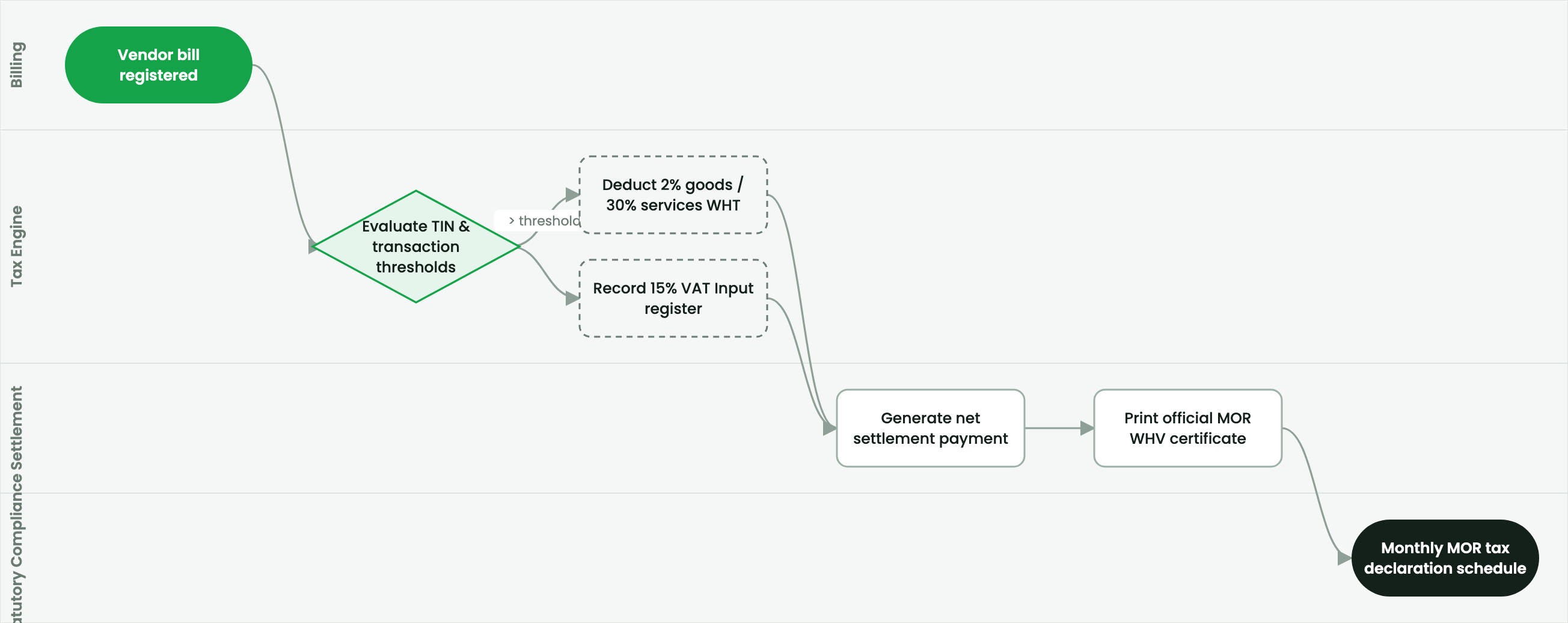
Under Ethiopian tax law (Proclamation No. 979/2016), Withholding Tax is calculated strictly on the VAT-exclusive base amount:
$$\text{Taxable Base} = \text{Gross Invoice Amount} - \text{VAT Amount}$$
$$\text{WHT Amount} = \text{Taxable Base} \times \text{WHT Rate}$$
$$\text{Net Settlement Payable} = \text{Gross Invoice Amount} - \text{WHT Amount}$$
Worked Example: Commercial Supply of Office Equipment#
A vendor supplies computer servers valued at ETB 100,000 plus 15% VAT:
- Taxable Base (Goods): ETB 100,000.00
- VAT @ 15%: ETB 15,000.00
- Gross Invoice Total: ETB 115,000.00
- WHT @ 2% on Goods (Exceeds ETB 10,000): $100,000 \times 0.02 = \text{ETB 2,000.00}$
- Net Cash/Bank Settlement to Vendor: $115,000 - 2,000 = \text{ETB 113,000.00}$
- Withholding Tax Payable to MOR: ETB 2,000.00
The resulting General Ledger posting is:
| Account Name | Code | Debit (ETB) | Credit (ETB) |
|---|---|---|---|
| IT Equipment Asset | 150100 | 100,000.00 | — |
| Input VAT Recoverable | 120300 | 15,000.00 | — |
| Accounts Payable (Vendor) | 210100 | — | 115,000.00 |
| At Payment Settlement: | |||
| Accounts Payable (Vendor) | 210100 | 115,000.00 | — |
| Bank Account (Disbursement) | 110200 | — | 113,000.00 |
| WHT Payable to MOR (2%) | 220200 | — | 2,000.00 |
Petty Cash Imprest System#
SmartERP manages petty cash using the classical fixed imprest model:
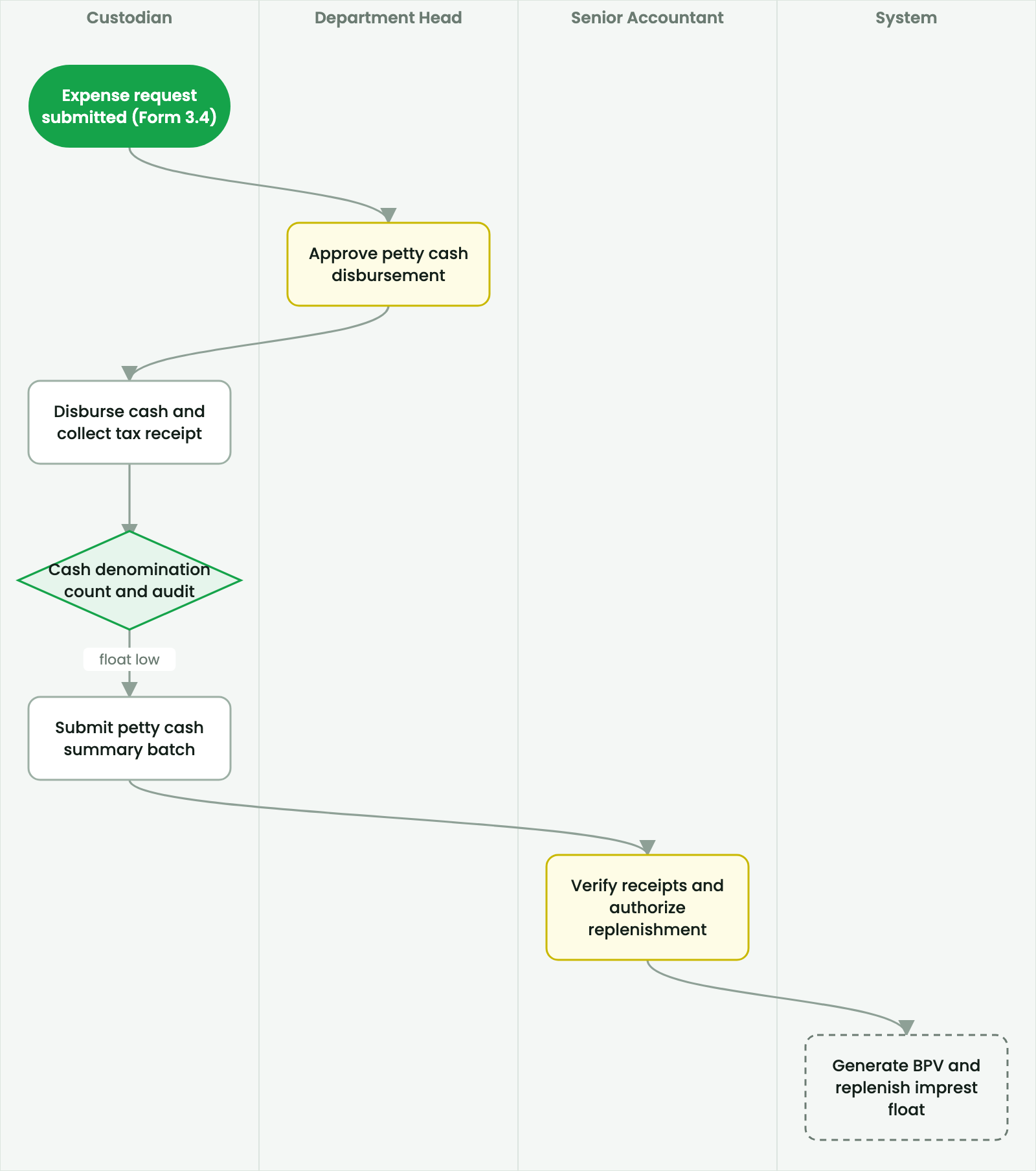
- Fixed Float: The fund maintains an approved ceiling (e.g., ETB 25,000).
- Current Cash + Valid Receipts = Approved Float: At any given moment, the physical cash in the safe plus submitted Petty Cash Payment Slips (PCPS / Form 3.4) must equal the total float.
- Replenishment Threshold: When physical cash falls below the threshold (e.g., 20% or ETB 5,000), a reconciliation batch is compiled, verified against receipts, and replenished via BPV.
4. Advanced Configuration Points#
- Automated Actions & Scheduled Tasks (Crons):
Account: Automatic reconciliation(account.ir_cron_auto_reconcile): Runs nightly to match open ledger transactionsAsset: Compute depreciation lines(account_asset.ir_cron_compute_depreciation): Runs monthly on the 30th to compute fixed asset depreciation schedulesTax: Generate VAT and WHT schedules(smarterp_finance.ir_cron_tax_schedules): Runs monthly to prepare MOR tax return summaries
- Custom Print Templates & Reports:
- Official Cash Receipt Voucher (CRV)
- Bank Payment Voucher (BPV) & Cheque Payment Voucher (CPV)
- Withholding Tax Certificate (Form 3.4)
- General Ledger & Trial Balance Audit Schedules
- Multi-Company Rules: Record-level security isolation under Company 1 (
Ashewa Technology Solutions S.C.), preventing cross-company ledger leakage across parent and subsidiary legal entities.
5. Comprehensive Troubleshooting Matrix#
| Error Symptom / Exception | Probable Root Cause | Corrective Action / Resolution |
|---|---|---|
Access Rights Error: Operation not allowed on account.move | User account lacks accounting operator privileges. | Assign the user to account.group_account_user or account.group_account_manager under Settings → Users. |
Validation Error: Missing analytic distribution | Selected general ledger account mandates cost center allocation for IFRS compliance. | Populate the analytic distribution column on all debit and credit lines before posting. |
Posting Blocked: Fiscal period closed | Transaction date falls within an immutable locked accounting period. | Select a transaction date within the open fiscal year or request an authorized period reopening under Accounting Settings. |
Tax Imbalance: WHT withholding variance | Withholding deduction does not match statutory 2% goods or 30% service rate. | Verify vendor TIN registration status in partner master and recalculate statutory tax lines. |
Next#
- Run a complete payment: Quick start.
- Deduct withholding tax: Calculate and deduct withholding tax.
- Set up petty cash: Set up petty cash fund.