Cascaded Scorecards & KPI Measurement Engine
The 4 Classic Perspectives, corporate-to-individual cascading architecture, KPI calculation mechanics, RAG status thresholds, and data integrity safeguards.
1. Overview & Business Value#
This comprehensive operational guide details the architecture, business workflows, configuration parameters, and execution steps for Cascaded Scorecards & KPI Measurement Engine within SmartERP.
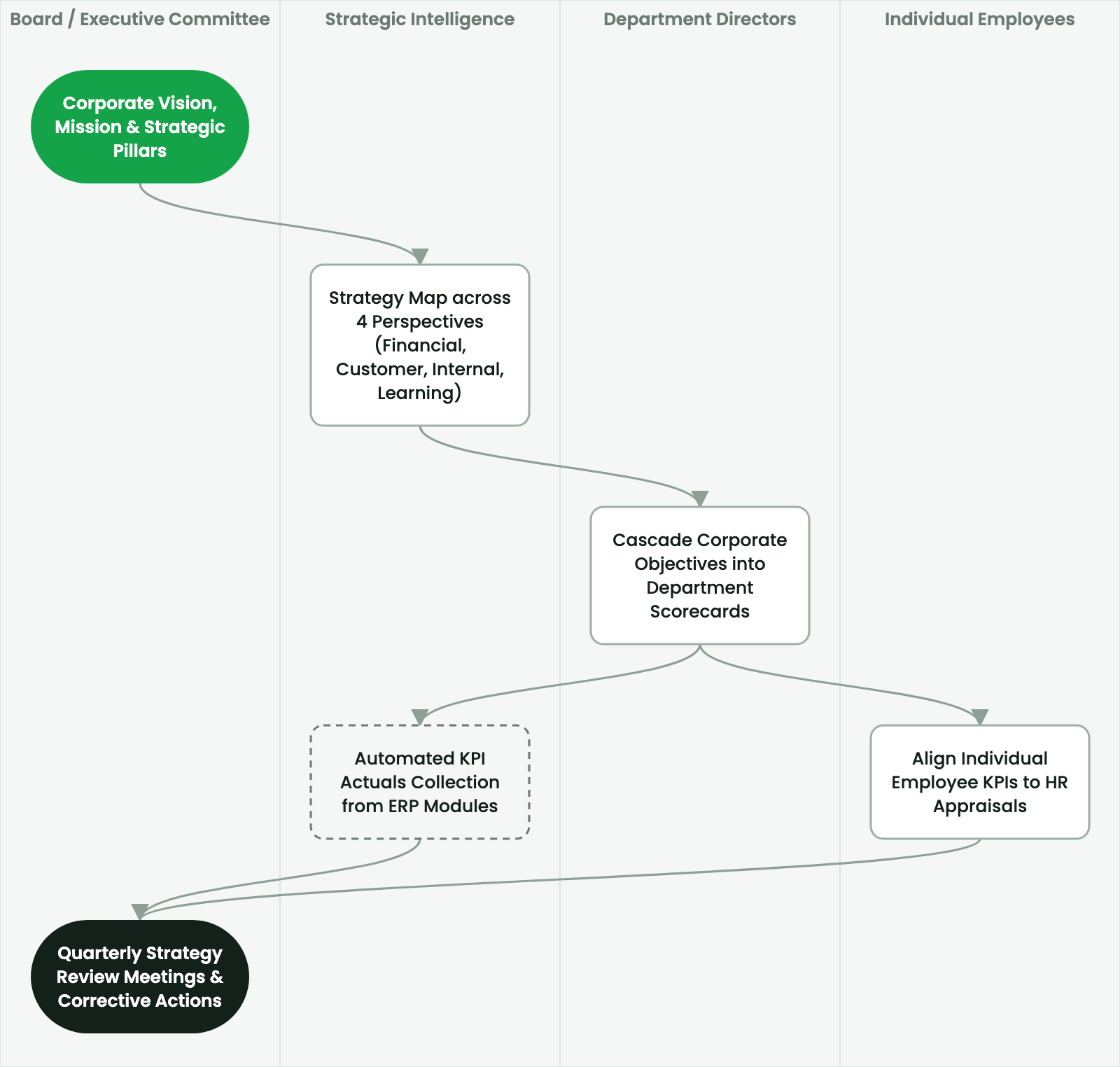
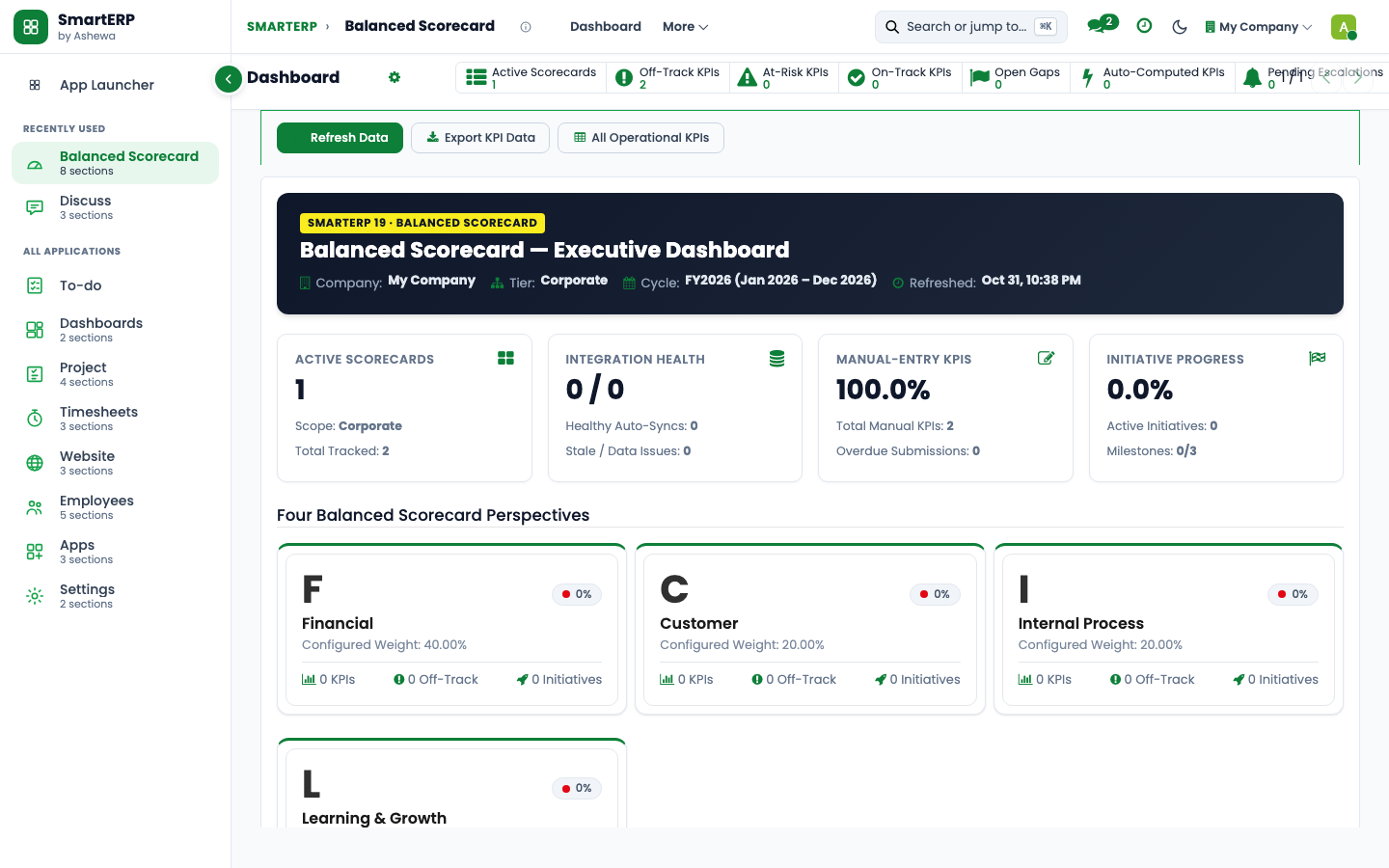
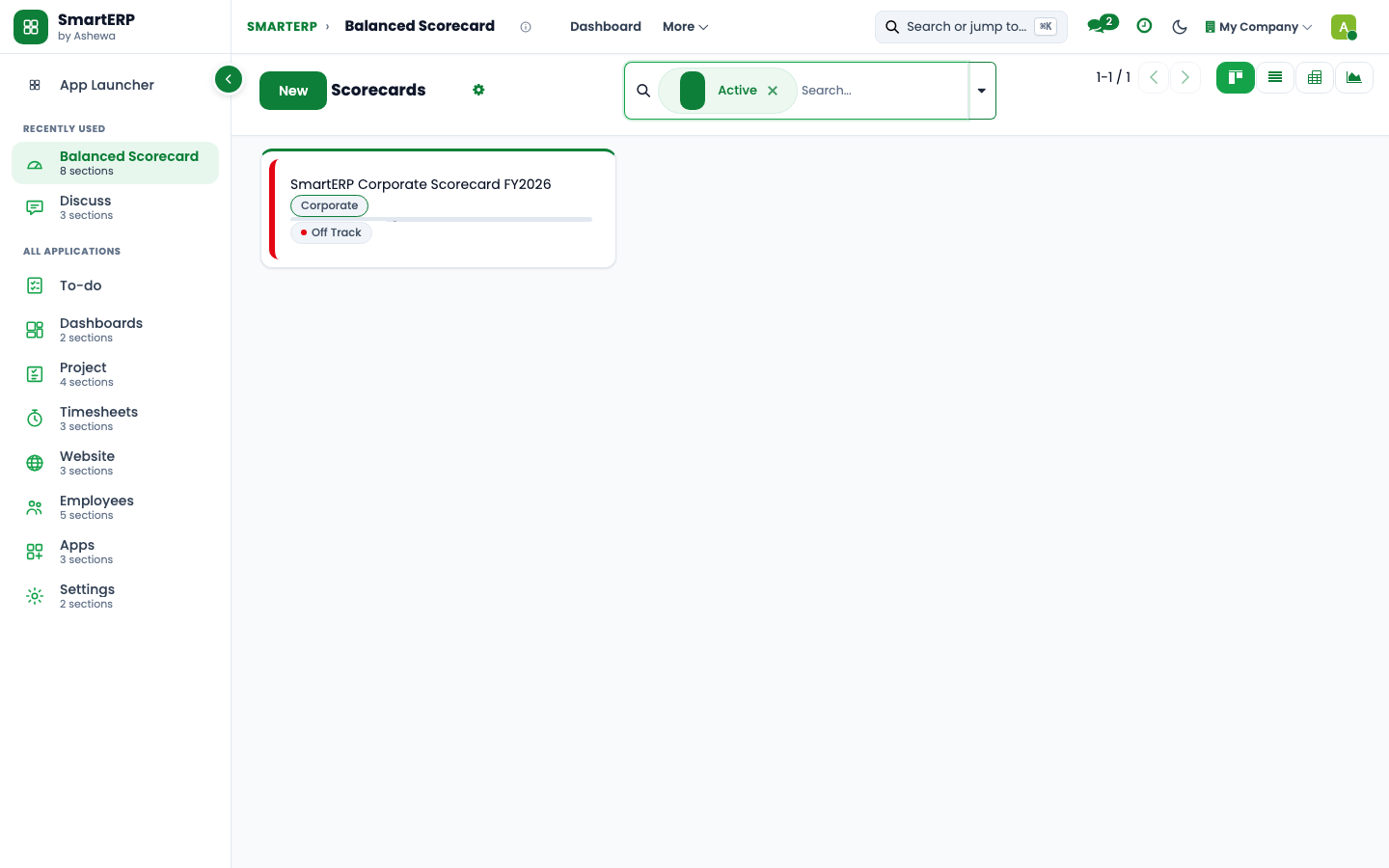
At the operational core of the platform is the Cascaded Scorecard Engine. Based on the foundational methodology developed by Dr. Robert Kaplan and Dr. David Norton, SmartERP provides a balanced, multidimensional view of performance that prevents short-term financial optimization at the expense of long-term organizational health.
2. Prerequisites & Security Access Groups#
- Required Modules:
smarterp_balanced_scorecard, smarterp_strategy - Security Groups:
Strategy Officer(Technical ID:smarterp_balanced_scorecard.group_bsc_user)Strategy Director(Technical ID:smarterp_balanced_scorecard.group_bsc_manager)Executive Committee Member(Technical ID:smarterp_balanced_scorecard.group_bsc_executive)
- Master Data Dependencies: Strategic themes, 4 BSC perspectives (Financial, Customer, Internal Process, Learning & Growth), corporate KPIs, and quarterly appraisal periods.
3. Step-by-Step Configuration & Execution#
Step 1: Navigating to the Interface#
- Log into your SmartERP instance at
https://smarterp.et/odoo. - Open the main App Switcher (grid icon in the top-left corner).
- Navigate to Balanced Scorecard → Strategic Dashboard.
Step 2: Operational Data Parameters & Controls#
Ensure all mandatory parameters comply with enterprise operational standards:
- Authorized Operator: Action executed under assigned RBAC permissions (Chief Executive Officer, Corporate Planning Director, Strategy Lead).
- Relational Integrity: Linked to upstream master records, approval requests, or transactional ledgers.
- Statutory & Quality Controls: Verified against Ethiopian statutory regulations and corporate governance standards.
Step 3: Operational Execution & State Progression#
- State Progression Gate: Advance record from Draft through Audited to Confirmed / Certified.
- Integrated System Impact: Automatically updates real-time operational states and posts financial/inventory journal moves.
- Audit Verification: System registers tamper-evident audit records logging user ID, timestamp, and cryptographic transaction digests.
The Four Classic Perspectives#
Every scorecard evaluates progress through four interconnected perspectives:
| Perspective | Core Question | Focus Area | Example Ethiopian Enterprise KPIs |
|---|---|---|---|
| 1. Financial | "To succeed financially, how should we appear to our shareholders?" | Financial health, profitability, cash flow, asset utilization, statutory compliance. | Annual Recurring Revenue (ARR), Gross Operating Margin %, EBITDA, Days Sales Outstanding (DSO), Net Operating Cash Flow. |
| 2. Customer / Market | "To achieve our vision, how should we appear to our customers?" | Customer value proposition, market penetration, brand equity, retention. | Commercial Enterprise Tenants, Net Promoter Score (NPS), Customer Churn Rate %, Average Revenue Per Account (ARPU). |
| 3. Internal Business Processes | "To satisfy our customers and shareholders, what business processes must we excel at?" | Operational velocity, product quality, service SLAs, regulatory throughput. | ERP Tenant Onboarding Cycle Time (Days), Core Platform Uptime SLA %, Customs ASYCUDA Clearance Duration (Hours), First Contact Resolution Rate. |
| 4. Learning & Growth | "To achieve our vision, how will we sustain our ability to change and improve?" | Human capital, technology capabilities, corporate culture, institutional memory. | Cloud Engineering Certification Count, Employee Annual Retention Rate %, Average Training Hours per FTE, AI Tool Adoption Rate. |
Multi-Tier Cascading Architecture#
Strategy fails when employees cannot see how their daily responsibilities connect to the company's annual goals. SmartERP BSC V3 provides a four-tier cascading hierarchy:
graph TD
    A["Corporate Master Scorecard (Tier 1)<br/>Owned by: Board of Directors & CEO"] --> B["Commercial Division Scorecard (Tier 2)<br/>Owned by: VP Sales & Marketing"]
    A --> C["Engineering & Cloud Ops Scorecard (Tier 2)<br/>Owned by: Chief Technology Officer"]
    A --> D["Finance & Shared Services Scorecard (Tier 2)<br/>Owned by: Chief Financial Officer"]
    B --> E["Enterprise Sales Team Scorecard (Tier 3)"]
    C --> F["DevOps & Platform Team Scorecard (Tier 3)"]
    E --> G["Individual Account Executive Scorecard (Tier 4)<br/>Owned by: Senior Account Rep"]
F --> H["Individual Cloud SRE Scorecard (Tier 4)<br/>Owned by: Senior Infrastructure Engineer"]- Parent-Child Linkage: Every subordinate scorecard links to its governing
parent_idscorecard. - Weight Rollup: Departmental results aggregate upwards into the corporate master score based on configured weighting parameters.
- Individual Employee Attribution: Individual scorecards link directly to the employee's
hr.employeerecord, allowing performance reviews to draw directly from verified system measurements rather than subjective memory.
Weight Balancing & Mathematical Integrity#
To ensure balanced strategic focus:
- Each perspective within a scorecard is assigned a Perspective Weight % (e.g., Financial 25%, Customer 25%, Processes 25%, People 25%).
- The sum of all active perspectives must total exactly 100%.
- Within each perspective, individual KPIs are assigned weights that must also total 100%.
- If a planner enters weights that total 200% or 80%, the system's
@api.constrainsvalidation prevents saving until the perspective is properly balanced.
KPI Scoring Mechanics & Directional Modes#
A Key Performance Indicator (bsc.kpi) defines a quantitative target. Performance is computed based on one of three directional scoring modes:
1. Increasing Mode (Higher is Better)#
Used for revenue, subscriber count, uptime %, or customer satisfaction:
$$\text{Achievement Score \%} = \left( \frac{\text{Actual Value}}{\text{Target Value}} \right) \times 100$$
2. Decreasing Mode (Lower is Better)#
Used for incident response time, defect rates, customer churn %, or cost overruns:
$$\text{Achievement Score \%} = \left( \frac{\text{Target Value}}{\text{Actual Value}} \right) \times 100$$
3. Range Mode (Target Within a Band)#
Used for inventory turnover days, working capital ratios, or temperature tolerances where both overshooting and undershooting carry operational penalties.
RAG Performance Status Thresholds#
Every measured KPI and scorecard is classified into an intuitive visual traffic-light status:
- 🟢 Green (On Track): Achievement $\ge 90.0\%$. Target is met or exceeded.
- 🟡 Amber / Yellow (Needs Attention): Achievement between $70.0\%$ and $89.9\%$. The metric is drifting off course; corrective operational intervention is recommended.
- 🔴 Red (Critical / Off Track): Achievement $< 70.0\%$. Significant strategic failure or operational breakdown.
Critical Data Integrity & Calculation Safeguards#
SmartERP BSC V3 includes five built-in mathematical safeguards:
- Missing Data Integrity Protection: If a KPI's target is zero, or if data has not yet been recorded for a period, the system scores the metric as $0.0\%$, never defaulting to a false $100\%$ green score.
- Future-Period Guard: When measuring monthly or quarterly periods across an annual cycle, future unelapsed periods are protected from being recorded as "measured zeros." They remain in an unmeasured pending state until their calendar period ends.
- Automated Escalation Guard: The system's automated escalation cron checks only periods where
actual_is_measured = Trueanddate_end <= today, ensuring employees are never penalized for unelapsed quarters. - Odoo 19 Aggregator Compatibility: Uses native Odoo 19
aggregatorparameters rather than deprecated Odoo 17/18.group_operatorattributes.
4. Advanced Configuration Points#
- Automated Actions & Scheduled Tasks (Crons):
BSC: Calculate quarterly KPI achievements(smarterp_bsc.ir_cron_compute_kpi): Runs quarterly on the 5th to compute composite achievement scoresBSC: Issue appraisal cascade reminders(smarterp_bsc.ir_cron_appraisal_alert): Runs monthly to remind objective champions to update progress
- Custom Print Templates & Reports:
- Institutional Balanced Scorecard Executive Dashboard
- Departmental Strategic Cascade Matrix
- KPI Performance Variance & Trend Analysis
- Corporate Strategy Execution Summary
- Multi-Company Rules: Record-level security isolation under Company 1 (
Ashewa Technology Solutions S.C.), preventing cross-company ledger leakage across parent and subsidiary legal entities.
5. Comprehensive Troubleshooting Matrix#
| Error Symptom / Exception | Probable Root Cause | Corrective Action / Resolution |
|---|---|---|
Weighting Error: Perspective weights do not equal 100% | Total weights assigned to objectives within perspective fail to sum to 100.00%. | Adjust individual objective weightings so the perspective total equals exactly 100%. |
Data Feed Error: Automated KPI metric returned null | Underlying model query failed or target database view has no records. | Verify connected model name and filter domain in the KPI automated calculation parameters. |
Lockout Error: Period results locked for executive review | Current appraisal quarter has been locked by the Strategy Director. | Obtain written authorization and request temporary unlock from the Strategy Director. |