MoH HMIS & DHIS2 Statutory Health Reporting
Automate monthly and annual Ministry of Health statutory indicators and generate direct data exports for the national DHIS2 portal.
1. Overview & Business Value#
This comprehensive operational guide details the architecture, business workflows, configuration parameters, and execution steps for MoH HMIS & DHIS2 Statutory Health Reporting within SmartERP.
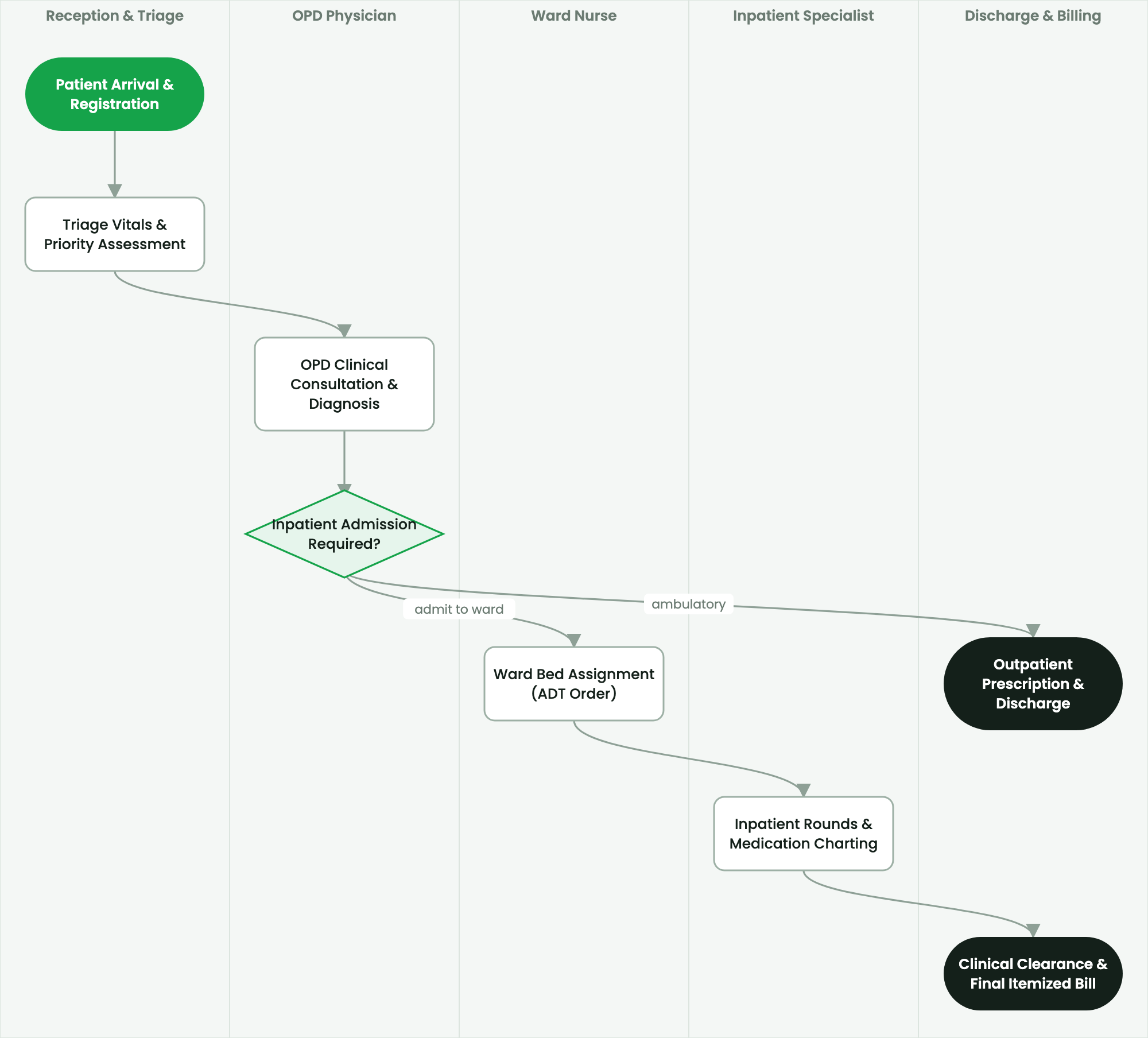
Automate monthly and annual Ministry of Health statutory indicators and generate direct data exports for the national DHIS2 portal.
2. Prerequisites & Security Access Groups#
- Required Modules:
smarterp_healthcare, smarterp_clinical_core, smarterp_pharmacy - Security Groups:
Healthcare Receptionist(Technical ID:smarterp_healthcare.group_medical_receptionist)Physician / Attending Doctor(Technical ID:smarterp_healthcare.group_medical_doctor)Pharmacy Dispenser(Technical ID:smarterp_healthcare.group_medical_pharmacist)
- Master Data Dependencies: Patient master registry (Medical Record Number - MRN), EFDA drug formulary, Ethiopian Ministry of Health (MoH) HMIS disease codes, and EHIS insurance tariffs.
3. Step-by-Step Configuration & Execution#
Step 1: Navigating to the Interface#
- Log into your SmartERP instance at
https://smarterp.et/odoo. - Open the main App Switcher (grid icon in the top-left corner).
- Navigate to Hospital → Patient Management → OPD / IPD.
Step 2: Operational Data Parameters & Controls#
Ensure all mandatory parameters comply with enterprise operational standards:
- Authorized Operator: Action executed under assigned RBAC permissions (Chief Medical Officer, Clinical Nurse, Receptionist, Pharmacist).
- Relational Integrity: Linked to upstream master records, approval requests, or transactional ledgers.
- Statutory & Quality Controls: Verified against Ethiopian statutory regulations and corporate governance standards.
Step 3: Operational Execution & State Progression#
- State Progression Gate: Advance record from Draft through Audited to Confirmed / Certified.
- Integrated System Impact: Automatically updates real-time operational states and posts financial/inventory journal moves.
- Audit Verification: System registers tamper-evident audit records logging user ID, timestamp, and cryptographic transaction digests.
National Health Management Information System (HMIS)#
Ethiopian healthcare institutions must submit monthly, quarterly, and annual performance indicators to the Ministry of Health (MoH) and Regional Health Bureaus. SmartERP eliminates manual tally sheets by calculating statutory indicators directly from transactional EMR, laboratory, pharmacy, and billing records.
Automated HMIS Indicator Aggregation#
- Navigate to Healthcare > Reports > Statutory MoH Reports > Monthly HMIS.
- Select the reporting period (e.g., Ethiopian Calendar Month
Meskerem 2019). - Click Compile HMIS Matrix.
- The system calculates indicators across standard national modules:
- OPD-1: Total outpatient attendance (disaggregated by age: $< 5$ years, $\ge 5$ years, and gender).
- IPD-1: Inpatient admissions, bed days, discharges, cure rate, and hospital mortality rate.
- MCH-1 through MCH-8: First ANC visits, 4th ANC visits, institutional deliveries, skilled birth attendance, cesarean section rate.
- EPI-1: Fully immunized children under 1 year of age.
- Morb-1: Top 10 causes of outpatient and inpatient morbidity coded by ICD-10.
DHIS2 Direct Electronic Integration#
SmartERP connects directly to the national DHIS2 instance using REST API webhooks:
flowchart LR
    A["SmartERP EMR & HIS"] --> B["HMIS Data Aggregator Engine"]
    B --> C["Validation & Discrepancy Gate"]
    C --> D["DHIS2 Data Value Set (JSON/XML)"]
D --> E["National MoH DHIS2 Server"]- Review the compiled indicators on the verification dashboard.
- Resolve any internal consistency warnings (e.g., number of deliveries exceeding number of female admissions).
- Click Export DHIS2 DataValueSets.
- Select direct API transmission or download the encrypted XML payload for manual upload in facilities with intermittent internet connectivity.
4. Advanced Configuration Points#
- Automated Actions & Scheduled Tasks (Crons):
Healthcare: Generate daily MoH HMIS aggregate tally(smarterp_healthcare.ir_cron_hmis_sync): Runs daily at 23:00 to prepare DHIS2 health data summariesPharmacy: Flag expiring EFDA medicine batches(smarterp_healthcare.ir_cron_fefo_expiry): Runs daily at 06:00 to alert dispensers of lots expiring within 60 days
- Custom Print Templates & Reports:
- Official Patient Encounter Summary & Medical Certificate
- Electronic Prescription Order Form (Model 19 Compliant)
- Ethiopian Health Insurance Service (EHIS) Claim Dossier
- Daily MoH Outpatient / Inpatient Morbidity Tally Sheet
- Multi-Company Rules: Record-level security isolation under Company 1 (
Ashewa Technology Solutions S.C.), preventing cross-company ledger leakage across parent and subsidiary legal entities.
5. Comprehensive Troubleshooting Matrix#
| Error Symptom / Exception | Probable Root Cause | Corrective Action / Resolution |
|---|---|---|
Access Block: Confidential clinical diagnosis restricted | User is not listed as the patient's attending physician or authorized consultant. | Request explicit clinical consultation delegation from the department head. |
Credit Ceiling Block: Corporate insurance expired | Patient corporate insurance policy limit exceeded or expired. | Switch billing mode to private cash settlement or upload pre-authorization approval from the insurer. |
FEFO Allocation Error: Expired medicine batch blocked | Dispenser selected medicine lot past statutory EFDA expiry date. | Isolate expired lot to quarantine storage and dispense compliant active lot. |