Nursing Care & Medication Administration Records (MAR)
Guide for ward nurses to execute doctor orders, maintain electronic MAR charting, record fluid balance, and perform shift handovers.
1. Overview & Business Value#
This comprehensive operational guide details the architecture, business workflows, configuration parameters, and execution steps for Nursing Care & Medication Administration Records (MAR) within SmartERP.
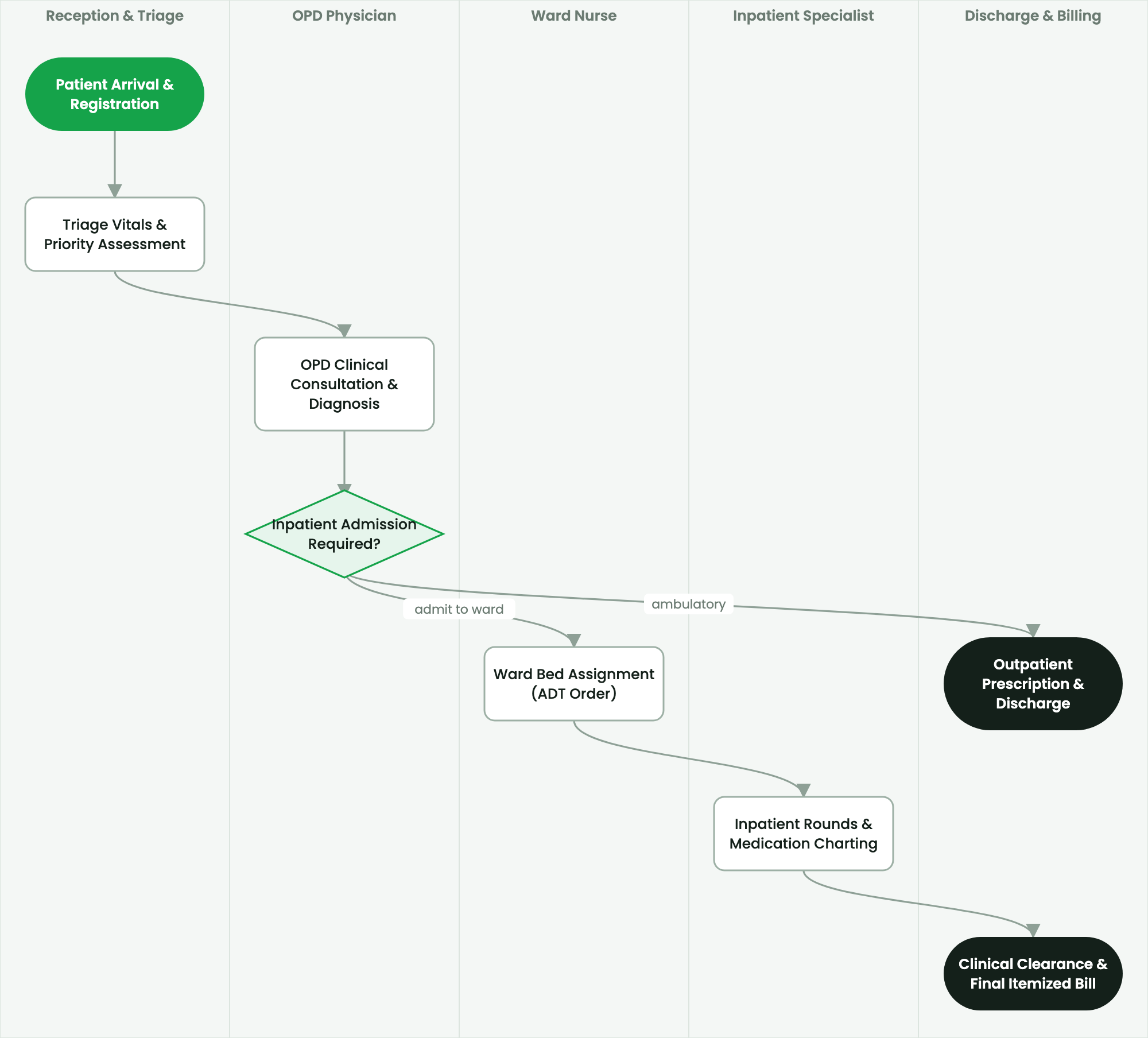
Guide for ward nurses to execute doctor orders, maintain electronic MAR charting, record fluid balance, and perform shift handovers.
2. Prerequisites & Security Access Groups#
- Required Modules:
smarterp_healthcare, smarterp_clinical_core, smarterp_pharmacy - Security Groups:
Healthcare Receptionist(Technical ID:smarterp_healthcare.group_medical_receptionist)Physician / Attending Doctor(Technical ID:smarterp_healthcare.group_medical_doctor)Pharmacy Dispenser(Technical ID:smarterp_healthcare.group_medical_pharmacist)
- Master Data Dependencies: Patient master registry (Medical Record Number - MRN), EFDA drug formulary, Ethiopian Ministry of Health (MoH) HMIS disease codes, and EHIS insurance tariffs.
3. Step-by-Step Configuration & Execution#
Step 1: Navigating to the Interface#
- Log into your SmartERP instance at
https://smarterp.et/odoo. - Open the main App Switcher (grid icon in the top-left corner).
- Navigate to Hospital → Patient Management → OPD / IPD.
Step 2: Operational Data Parameters & Controls#
Ensure all mandatory parameters comply with enterprise operational standards:
- Authorized Operator: Action executed under assigned RBAC permissions (Chief Medical Officer, Clinical Nurse, Receptionist, Pharmacist).
- Relational Integrity: Linked to upstream master records, approval requests, or transactional ledgers.
- Statutory & Quality Controls: Verified against Ethiopian statutory regulations and corporate governance standards.
Step 3: Operational Execution & State Progression#
- State Progression Gate: Advance record from Draft through Audited to Confirmed / Certified.
- Integrated System Impact: Automatically updates real-time operational states and posts financial/inventory journal moves.
- Audit Verification: System registers tamper-evident audit records logging user ID, timestamp, and cryptographic transaction digests.
Electronic Medication Administration Record (e-MAR)#
The e-MAR module eliminates paper medication sheets, verifying the Five Rights of Medication Administration:
- Right Patient (Barcode MRN scan)
- Right Medication (Barcoded dose unit)
- Right Dose
- Right Route (Oral, IV, IM, SC, Topical)
- Right Time (Scheduled administration window)
Administering Scheduled Inpatient Medications#
- Open Healthcare > Inpatient > Nursing Station > Medication Chart.
- Select the assigned ward and room.
- Review the timeline of scheduled doses (e.g., 08:00, 14:00, 20:00).
- Scan the patient's wristband barcode or verify identity via MRN.
- Click on the due medication line (e.g.,
Ceftriaxone 1g IV Stat). - Select the administration status:
- Given: Enter exact administration timestamp and injection site.
- Refused: Record clinical reason and notify attending doctor.
- Held / Omitted: Specify clinical contraindication (e.g., SBP $< 90\, mmHg$ prior to anti-hypertensive).
- Digitally sign the administration entry.
Fluid Intake & Output (I/O) Balance#
Accurate fluid balance monitoring is critical for surgical, cardiac, and renal inpatients:
- Intake: IV infusions, blood products, oral fluids, enteral feeding tube volumes.
- Output: Urine output (catheter / urinal), surgical drain volumes, nasogastric aspirate, emesis.
The system calculates net fluid balance every 12 and 24 hours:
$$\text{Net Balance} = \sum \text{Intake (mL)} - \sum \text{Output (mL)}$$
Alerts trigger if hourly urine output falls below $0.5\, mL/kg/hr$ in adult patients.
Structured Nursing Shift Handover (SBAR)#
At shift change, nursing teams conduct handovers utilizing the standardized SBAR framework:
- Situation: Patient name, age, day of admission, admitting diagnosis.
- Background: Relevant medical history, surgical procedures, drug allergies.
- Assessment: Current vital signs, neurological status, IV lines, drain outputs, active lab results.
- Recommendation: Pending diagnostic investigations, scheduled medication changes, planned discharges.
4. Advanced Configuration Points#
- Automated Actions & Scheduled Tasks (Crons):
Healthcare: Generate daily MoH HMIS aggregate tally(smarterp_healthcare.ir_cron_hmis_sync): Runs daily at 23:00 to prepare DHIS2 health data summariesPharmacy: Flag expiring EFDA medicine batches(smarterp_healthcare.ir_cron_fefo_expiry): Runs daily at 06:00 to alert dispensers of lots expiring within 60 days
- Custom Print Templates & Reports:
- Official Patient Encounter Summary & Medical Certificate
- Electronic Prescription Order Form (Model 19 Compliant)
- Ethiopian Health Insurance Service (EHIS) Claim Dossier
- Daily MoH Outpatient / Inpatient Morbidity Tally Sheet
- Multi-Company Rules: Record-level security isolation under Company 1 (
Ashewa Technology Solutions S.C.), preventing cross-company ledger leakage across parent and subsidiary legal entities.
5. Comprehensive Troubleshooting Matrix#
| Error Symptom / Exception | Probable Root Cause | Corrective Action / Resolution |
|---|---|---|
Access Block: Confidential clinical diagnosis restricted | User is not listed as the patient's attending physician or authorized consultant. | Request explicit clinical consultation delegation from the department head. |
Credit Ceiling Block: Corporate insurance expired | Patient corporate insurance policy limit exceeded or expired. | Switch billing mode to private cash settlement or upload pre-authorization approval from the insurer. |
FEFO Allocation Error: Expired medicine batch blocked | Dispenser selected medicine lot past statutory EFDA expiry date. | Isolate expired lot to quarantine storage and dispense compliant active lot. |