Dry Hulling, Industrial Milling & Yield Loss Accounting
Manage dry mill hulling operations, screen size separation, gravity density tables, optical color sorting, and byproduct accounting.
1. Overview & Business Value#
This comprehensive operational guide details the architecture, business workflows, configuration parameters, and execution steps for Dry Hulling, Industrial Milling & Yield Loss Accounting within SmartERP.
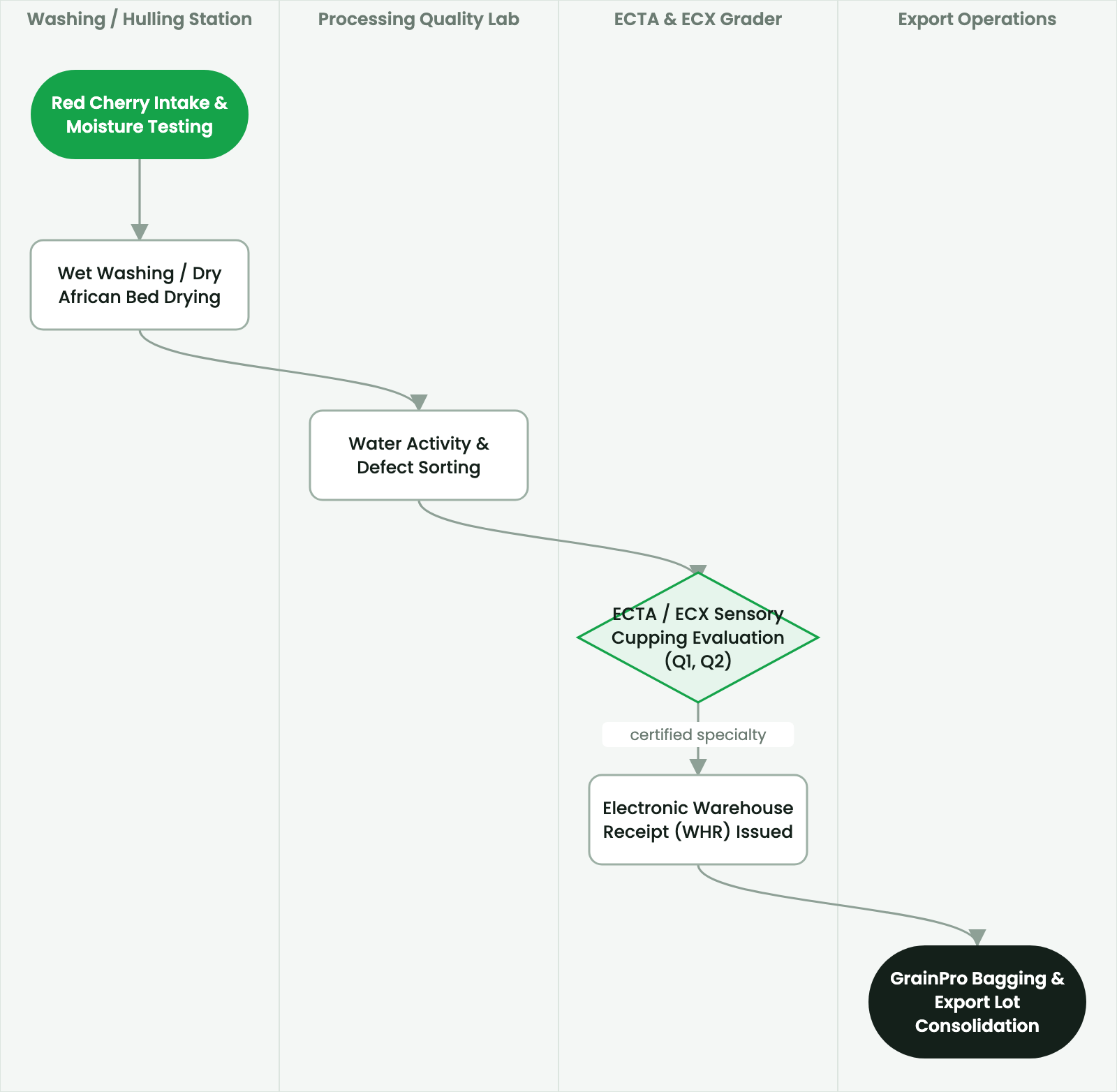
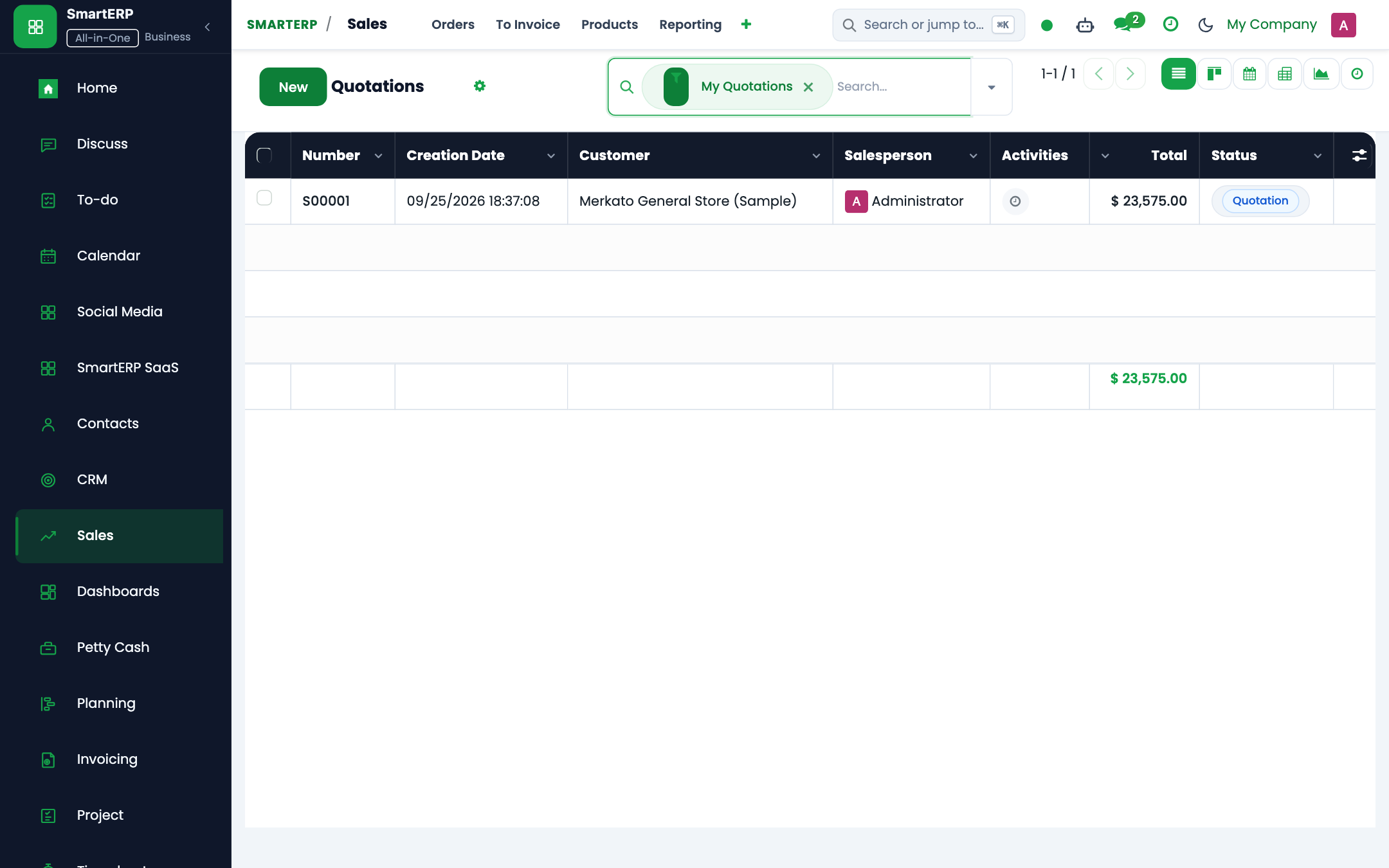
Manage dry mill hulling operations, screen size separation, gravity density tables, optical color sorting, and byproduct accounting.
2. Prerequisites & Security Access Groups#
- Required Modules:
smarterp_commodity_export, smarterp_agri_traceability - Security Groups:
Export Logistics Officer(Technical ID:smarterp_export.group_export_user)Coffee Quality Lab Grader (Q-Grader)(Technical ID:smarterp_export.group_export_qa)Export Commercial Director(Technical ID:smarterp_export.group_export_manager)
- Master Data Dependencies: Coffee origination zones (Yirgacheffe, Sidama, Guji, Jimma, Harar), ECX contracts, washing stations, export container lots, and NBE 50/50 FX retention accounts.
3. Step-by-Step Configuration & Execution#
Step 1: Navigating to the Interface#
- Log into your SmartERP instance at
https://smarterp.et/odoo. - Open the main App Switcher (grid icon in the top-left corner).
- Navigate to Coffee Export → Origination → Lots.
Step 2: Operational Data Parameters & Controls#
Ensure all mandatory parameters comply with enterprise operational standards:
- Authorized Operator: Action executed under assigned RBAC permissions (Export General Manager, Cupper/Q-Grader, Export Logistics Lead).
- Relational Integrity: Linked to upstream master records, approval requests, or transactional ledgers.
- Statutory & Quality Controls: Verified against Ethiopian statutory regulations and corporate governance standards.
Step 3: Operational Execution & State Progression#
- State Progression Gate: Advance record from Draft through Audited to Confirmed / Certified.
- Integrated System Impact: Automatically updates real-time operational states and posts financial/inventory journal moves.
- Audit Verification: System registers tamper-evident audit records logging user ID, timestamp, and cryptographic transaction digests.
Dry Milling Industrial Process Flow#
Parchment coffee (or dried cherry pods for natural coffees) must be hulled and polished into export-ready green coffee beans:
- Pre-Cleaning: Destoners eliminate stones, soil clods, and metal debris.
- Hulling: Impact hullers crack and strip dried parchment husks.
- Polishing: Friction polishers remove the thin silverskin layer.
- Grading by Size: Vibrating screen decks sort beans by screen size (Screen 17/18 Large, Screen 15/16 Medium, Screen 14 Small).
- Density Separation: Gravity separator tables float low-density defective beans away from dense specialty beans.
- Bichromatic Optical Sorting: High-speed optical color sorters reject discolored, black, sour, or insect-damaged beans with high-pressure air nozzles.
Calculating Standard Milling Yield Ratios#
SmartERP MRP tracks yield losses across batches:
$$\text{Clean Coffee Yield Ratio} = \frac{\text{Clean Green Coffee Weight (kg)}}{\text{Raw Parchment Weight (kg)}} \times 100\%$$
- Standard Washed Parchment: 78% – 82% clean green coffee yield (18% – 22% husk loss).
- Natural Dried Cherry (Jenfel): 48% – 52% clean green coffee yield (48% – 52% pod husk loss).
If yield drops below standard thresholds (e.g., clean yield $< 75\%$), the system flags an excess loss alert, prompting immediate inspection of huller clearance and screen mesh wear.
4. Advanced Configuration Points#
- Automated Actions & Scheduled Tasks (Crons):
Export: Track NBE 50/50 FX retention account expiration(smarterp_export.ir_cron_fx_retention): Runs weekly to monitor statutory 30-day conversion windowsTraceability: Monitor container transit milestones(smarterp_export.ir_cron_container_tracking): Runs daily to update Modjo dry port to Djibouti customs handoffs
- Custom Print Templates & Reports:
- ECTA Coffee Quality & Traceability Inspection Dossier
- Export Commercial Invoice, Packing List & Certificate of Origin
- Bole Cargo / Modjo Dry Port Multimodal Shipping Manifest
- NBE Foreign Exchange Retention & Commercial Bank Allocation Slip
- Multi-Company Rules: Record-level security isolation under Company 1 (
Ashewa Technology Solutions S.C.), preventing cross-company ledger leakage across parent and subsidiary legal entities.
5. Comprehensive Troubleshooting Matrix#
| Error Symptom / Exception | Probable Root Cause | Corrective Action / Resolution |
|---|---|---|
FX Retention Block: 50% ETB conversion window expired | Foreign proceeds not converted to local currency within mandatory 30-day window per NBE directives. | Contact commercial bank international banking department to process statutory conversion. |
Quality Grade Rejection: Moisture content exceeds 12.0% | Export sample failed ECTA moisture tolerance threshold. | Return lot to processing facility for further mechanical or sun drying prior to re-sampling. |
Customs Clearance Missing: Phytosanitary certificate not attached | Mandatory Ministry of Agriculture clearance document missing from shipment file. | Complete inspection sampling and attach approved certificate before filing Modjo customs manifest. |